In 2026, your brand is either a high-performance growth engine or an expensive anchor. There is no middle ground. You’ve likely seen the Sydney market become saturated with generic, AI-driven competitors that look and sound exactly like everyone else. It’s exhausting. We understand the struggle of trying to articulate your unique value to investors while your digital channels feel disjointed and inconsistent. Learning how to create a brand strategy for a startup is the only way to reclaim your narrative and stop the friction.
This guide delivers the exact framework needed to build a high-growth brand that commands attention and scales with precision. We’ll skip the fluff. We’ll dive straight into the mechanics of positioning, investor resonance, and total cross-channel consistency. You’ll gain a clear roadmap to move beyond basic logos and create a unified identity that actually converts. It’s time to turn your brand into your most powerful operating system for growth.
Key Takeaways
- Escape the “AI Sameness” trap by building a strategic identity that functions as your startup’s operating system for growth.
- Master how to create a brand strategy for a startup by defining your core problem with brutal specificity and a “different over better” mindset.
- Construct a scalable visual and verbal language that leverages psychological triggers to cut through the saturated Sydney market.
- Follow a disciplined five-step roadmap to align internal stakeholders and benchmark your position against competitors effectively.
- Connect high-level strategy with technical execution to drive higher conversion rates on Shopify and across all digital channels.
Why Brand Strategy is Your Startup’s Growth Engine in 2026
Your brand strategy is not a creative luxury. It is the blueprint for how the world perceives, trusts, and interacts with your startup. In the high-stakes Sydney market, it functions as your operating system. Without it, you are just another founder with a pitch deck and a prayer. Understanding how to create a brand strategy for a startup is the difference between a company that scales and one that disappears into the background noise.
The “AI Sameness” trap is real. By 2026, the barrier to entry for content and design has vanished. Everyone has access to the same generative tools. This has created a sea of generic competitors who look identical and sound robotic. If your brand is built on prompts rather than purpose, you’ve already failed. True brand equity is what allows you to command a premium valuation during a Series A round in NSW. Investors don’t just back products; they back identities that can own a category.
Establishing this identity requires a deep dive into your communications strategy; you can read more about how Brand Central helps businesses build strategic identities that resonate with global audiences.
Strategy must always precede execution. Jumping into Facebook ads or TikTok Shop without a core narrative is like building a house without a foundation. It’s expensive. It’s inefficient. It’s a recipe for high churn. A rigorous approach to brand management ensures every dollar spent on marketing actually builds long-term value instead of just buying temporary attention.
The Difference Between Brand Strategy, Identity, and Marketing
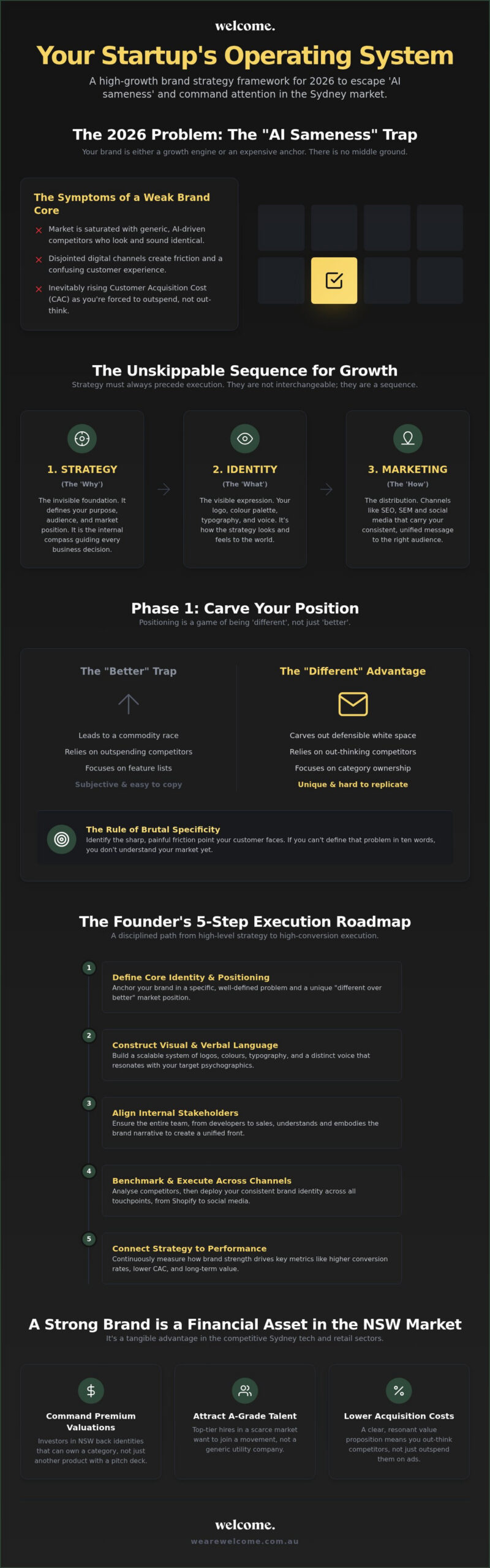
Founders often confuse these three pillars. They aren’t interchangeable. They are a sequence. You cannot skip a step and expect results.
- Strategy: The invisible foundation. It defines your “why,” your “who,” and your “how.” It is the internal compass that guides every business decision.
- Identity: The visible expression. This is your logo, your colour palette, and your typography. It’s how the strategy looks and feels to the outside world.
- Marketing: The distribution. These are the channels like SEO, SEM, and social media that carry your message to the world.
Why Sydney Startups Fail Without a Strategic Core
The competitive landscape in the NSW tech and retail sectors is tighter than ever. A weak brand doesn’t just look bad; it’s a financial liability. Without a clear strategic core, your Customer Acquisition Cost (CAC) will inevitably climb. You’ll be forced to outspend competitors on ads because you can’t out-think them on value. In a market where talent is scarce, a bold brand also acts as a magnet for top-tier hires. People don’t want to work for a generic utility. They want to work for a movement. If you can’t articulate that movement, you’ll struggle to retain the people who build your product.
Phase 1: Defining Your Core Identity and Positioning
Positioning is where most founders stumble. They go broad. They try to be everything to everyone. When learning how to create a brand strategy for a startup, the first rule is brutal specificity. You must identify the exact problem you solve. This isn’t a vague “efficiency” play. It’s a sharp, painful friction point that keeps your target user awake at 2 am. If you can’t define that problem in ten words, you don’t understand your market yet.
Forget being “better.” Better is subjective. Better is a commodity. In 2026, you must be different. Use the “Different > Better” framework to carve out white space in the NSW market. Analyse your competitors. Look at what they are afraid to say. While they chase the same safe features, you should chase a unique perspective. Many startups find success by adopting branding strategies from established businesses that prioritise category ownership over feature lists. This is how you build a mission statement that doesn’t just sit on a wall. It needs to ring true for a Surry Hills developer and a venture capitalist in Barangaroo. It must be a rallying cry for your team and a promise to your market.
The Customer Persona Deep-Dive
Demographics are dead. Knowing your user is 25 to 34 and lives in Paddington tells you nothing about why they buy. Focus on psychographics and “Jobs to be Done.” What is the emotional progress they’re trying to make? Sydney consumers are sophisticated. They value time, status, and seamless integration. Your “Primary User” profile should be a vivid portrait of a single person. Every strategic decision must pass through their filter. If it doesn’t solve their specific job, it’s waste.
Developing a Brand Voice That Sounds Human
The era of “professional yet approachable” is over. It’s a hollow trope. It’s safe. It’s boring. By 2026, your voice needs edges. It needs a vocabulary that feels earned, not generated. Stop using industry jargon that sounds like a LinkedIn bot. Instead, build a lexicon that reflects your startup’s unique soul. This isn’t just about what you say. It’s about the rhythm of your sentences. It’s about the words you choose to ignore. Our brand and strategy experts often help founders strip away the corporate polish to find a voice that actually resonates. Our brand voice is: Bold, rhythmic, and unapologetic.
Phase 2: Building the Visual and Verbal Brand Identity
Visual identity is the skin of your strategy. It needs to be resilient. Once you’ve mastered how to create a brand strategy for a startup, you must translate that abstract foundation into a high-performance visual system. In 2026, your brand doesn’t just live on a desktop. It lives in the palm of a hand, flickering across TikTok feeds and Shopify checkouts. If your identity doesn’t scale down to a 16-pixel favicon or up to a digital billboard on the M4, it’s broken.
Colour and typography in 2026 are about more than just aesthetics. They are about digital psychology and accessibility. High-contrast palettes aren’t just a trend; they are a necessity for mobile-first users. Your chosen typeface must balance premium character with lightning-fast load times. Performance is a brand attribute. A slow-loading site or a blurry social asset signals a lack of technical competence. Your visual language must be engineered for speed and clarity across every touchpoint.
The Elements of a Modern Startup Identity
A single logo is no longer enough. You need a responsive logo system. This includes a primary mark, a simplified icon for social avatars, and a wordmark for horizontal headers. Consistency is the goal. Understanding how to create a brand strategy for a startup means ensuring your typography is web-accessible, maintaining legibility while projecting a sophisticated edge. Stop using tired stock photography. Authentic, high-impact creative is the only way to cut through the AI-generated noise. Invest in original assets that reflect the real energy of your Sydney-based team and product.
Verbal Branding: Naming and Messaging
Your name is your most permanent strategic asset. In Australia, an ownable name must clear IP Australia trademark hurdles and be available as a clean .com.au or .com domain. It needs to be memorable, easy to spell, and free of accidental cultural baggage. Once named, build a messaging hierarchy. This starts with a punchy H1 that captures your USP and flows down to meta descriptions that drive clicks. Consistency is vital. Whether it’s a high-level investor deck or an automated SMS notification, the voice must remain unified. Every word is an opportunity to reinforce your brand’s personality and build trust with your audience.
Phase 3: The 5-Step Execution Roadmap for Founders
Theory is cheap. Execution is where the value lives. Knowing how to create a brand strategy for a startup is useless if you can’t translate it into a repeatable process. This five-step roadmap ensures your brand isn’t just a slide deck but a living asset that drives results from day one. It requires discipline, coordination, and a refusal to settle for generic outputs.
- Step 1: Internal Discovery. Start with a value audit. Interview your stakeholders. Strip away the ego to find the true core of your business. What are you actually building?
- Step 2: Market Research. Benchmark against the Sydney competition. Test your messaging with real users. Don’t assume you know what they want; prove it with data.
- Step 3: Strategic Framework. Build your Brand House. This document defines your purpose, values, and positioning statement. It is your single source of truth for every future decision.
- Step 4: Identity Design. Create the assets. This includes your logo system, typography, and verbal messaging hierarchy. It is the visual and verbal manifestation of your strategy.
- Step 5: Brand Activation. Launch. Orchestrate your entry across digital and physical touchpoints to create maximum impact and immediate recognition.
Managing Your Brand Launch in the Sydney Market
Sydney is a crowded room. You cannot shout at everyone. Prioritise the channels where your audience actually spends their time. Whether it’s a high-performance Shopify store or a targeted LinkedIn campaign, your launch must be professional and cohesive. Partnering with a creative agency sydney founders trust can help you navigate this complexity. They ensure your strategy isn’t lost in the transition to creative. Measure resonance early. Use social sentiment and direct feedback to gauge if your message is landing or if you need a rapid pivot. Speed is your advantage; use it.
Scaling Your Brand Post-Launch
Launch day is only the beginning. As your team grows, consistency becomes your biggest challenge. Create a Brand Bible. This isn’t just a PDF; it’s a living document that keeps every new hire aligned. Iteration is key. Use real-world market data to refine your positioning. If you are eyeing a Series A, your brand must be ready for scrutiny. Investors look for a unified identity that suggests maturity and scalability. If you are ready to professionalise your presence and build a brand that scales, book a strategy session with our team today.
Integrating Strategy with Performance: The Welcome Approach
Performance without strategy is just expensive noise. Most founders view brand as a “creative” task and marketing as a technical one. This siloed thinking is why so many startups plateau. When you master how to create a brand strategy for a startup, you aren’t just making things look pretty. You’re building the engine that drives your paid ads, your organic reach, and your customer loyalty. Strategy-led creative will outperform generic “best-practice” ads every single time because it speaks to a specific human truth that AI cannot replicate.
This strategic core is what informs high-performance shopify web design sydney founders use to crush their conversion targets. A website shouldn’t just be a shopfront. It must be a digital manifestation of your brand promise. Every button, every product description, and every micro-interaction should reinforce your positioning. When your brand authority is clear, your SEO and organic growth follow. Google rewards entities, not just keywords. A strong brand identity signals trust, reducing your reliance on ever-increasing ad spend.
Stop looking for a “marketing agency” that just executes tasks. You need a strategic partner that understands the holistic journey. We don’t just run ads; we coordinate a unified assault on the market. This integration removes the friction between what you say and what you do. It ensures that your brand equity grows with every transaction. It’s about total alignment.
Multi-Channel Consistency: From TikTok to Email
Your brand story must remain unbroken across every touchpoint. A customer might discover you on TikTok Shop Australia, browse on your mobile-optimised store, and receive an SMS notification. If the voice changes or the energy drops, you lose them. Lifecycle marketing is where your brand promise is either kept or broken. We ensure your verbal and visual identity translates seamlessly into short-form video and automated email flows. This unified presence is the secret to building long-term customer Lifetime Value (LTV) in a market that is increasingly distracted.
Why Integrated Agencies are the Best Fit for High-Growth Startups
Speed is the primary currency for Sydney startups. Friction is the enemy. By choosing an integrated partner, you remove the gap between strategy and execution. There is no “handover” where the vision gets lost. You get a single point of contact for your entire digital ecosystem. Welcome helps startups dominate their niche by ensuring that every SEO tactic, every creative asset, and every line of code serves the overarching strategy. We don’t just build brands; we build market leaders. It’s time to move beyond fragmented tactics and embrace a unified approach to growth.
Build Your 2026 Growth Engine Today
The era of generic branding is over. In a market flooded with AI-generated noise, your startup’s survival depends on a strategy that is as technically sound as it is creatively bold. You’ve now seen how to move beyond basic identity to build a comprehensive operating system for growth. Mastering how to create a brand strategy for a startup ensures that every touchpoint, from your Shopify store to your TikTok feed, works in total alignment. It’s about creating a unified narrative that investors trust and customers remember.
Welcome is an independent integrated agency based in Sydney. We are specialists in high-performance Shopify and multi-channel growth, delivering a no-nonsense, results-driven approach for ambitious founders. We don’t just design; we coordinate. We don’t just market; we scale. If you’re tired of fragmented tactics and ready for a partner that handles the complexity of execution with elite precision, we’re ready to start. Ready to build a brand that scales? Let’s talk strategy.
The Sydney market moves fast. Don’t let your brand be the anchor that holds you back. Take the framework, start the discovery, and build the future your startup deserves.
Frequently Asked Questions
Do I really need a brand strategy before I have a product-market fit?
Yes. Strategy is the compass that leads you to product-market fit. It defines the specific problem you’re solving and for whom. Without this clarity, your product development is just guesswork. Understanding how to create a brand strategy for a startup early on prevents expensive pivots and ensures your MVP actually resonates with the right Sydney audience. It’s about building a foundation that supports your product’s evolution.
How is brand strategy different from a marketing plan?
Strategy is your identity; marketing is your distribution. Strategy defines your positioning, voice, and values. It is the “why” behind your business. A marketing plan is the “how,” focusing on specific channels like TikTok Shop or SEO to reach users. Strategy is the permanent foundation. Marketing is the tactical layer that changes based on performance data and market shifts. You need the former to make the latter effective.
Can I use AI to create my startup brand strategy in 2026?
AI is a tool for research, not a substitute for strategy. If you let a bot define your brand, you’ll end up with the “AI Sameness” that plagues the current market. A high-growth brand requires human intuition and brutal specificity. Use AI to organise data or brainstorm names. Leave the strategic positioning and emotional resonance to experts who understand the nuances of the NSW landscape. Originality is your only competitive advantage.
How much does a professional brand strategy cost for an Australian startup?
Costs vary significantly based on your startup’s stage and the scope of work required. A pre-seed founder might work with a boutique consultant for a focused positioning document. A Series A startup usually requires a comprehensive system from an integrated agency. This often includes strategy, visual identity, and pitch deck resonance. The investment reflects the complexity of the market you intend to disrupt and the scale of your ambitions.
How long does it take to develop a comprehensive brand strategy?
A rigorous process typically takes between 4 and 12 weeks. This timeframe accounts for internal discovery, stakeholder interviews, and deep market research. Rushing this phase is a mistake. You need time to test messaging and ensure your visual identity scales across all digital touchpoints. A solid foundation saves months of rebranding work down the line. It’s an investment in your startup’s long-term speed and efficiency.
When should we consider rebranding our startup?
Rebrand when your current identity creates friction or no longer reflects your product’s reality. This often happens before a major capital raise or when entering a new vertical. If your Customer Acquisition Cost is climbing because your message is disjointed, your brand is failing you. A rebrand isn’t just a new logo; it’s a strategic realignment with your growth goals. It ensures your external image matches your internal capability.
What are the most common branding mistakes startups make?
The biggest mistake is skipping strategy to jump straight into design. Founders often settle for generic, safe identities that disappear in the Sydney market. Another common error is failing to build a mobile-first identity. If your brand looks great on a 27-inch monitor but breaks on a smartphone, you’re losing the majority of your audience. Inconsistency is the ultimate brand killer. Every touchpoint must feel like it belongs to the same company.
How do we measure the ROI of our brand strategy?
Measure ROI through lower Customer Acquisition Costs and higher Lifetime Value. A strong brand strategy increases trust, which leads to better conversion rates across your Shopify store and social channels. You’ll also see it in your investor pitch deck resonance. When your value proposition is clear, the path to funding becomes significantly smoother. Strategy turns your brand into a measurable asset that compounds in value over time.